
The Complete Guide to Building a Powerful Online Brand
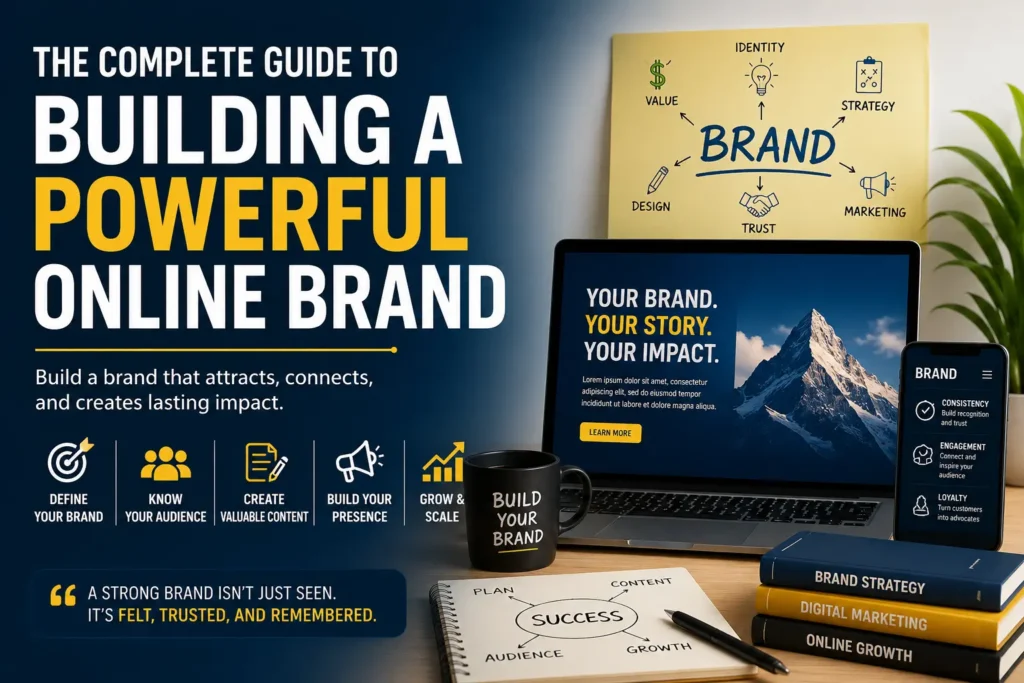
If you have ever searched for a product online and chosen one company over another without being entirely sure why, you have already experienced the quiet power of a strong brand. Something about the way it looked, the way it spoke, or the way it made you feel tipped the decision in its favor. That is branding working exactly as it should — not through pressure or flashy promises, but through a consistent impression that builds over time until trust becomes almost automatic.
Building an online brand can feel overwhelming, especially when you are starting from scratch or trying to make sense of advice that seems to contradict itself. Some people will tell you that your logo is everything. Others insist that content is the only thing that matters. The truth is that a strong brand is the result of many things working together — strategy, visuals, language, consistency, and a genuine understanding of the people you want to reach.
This guide walks through every stage of that process in a way that is practical, honest, and grounded in what actually works. Whether you are building a brand for the first time or trying to strengthen one that already exists, there is something here that will move you forward.
Table of Contents
- Understanding What an Online Brand Really Means
- Laying the Foundation: Research, Strategy, and Positioning
- Building the Visual and Verbal Identity of Your Brand
- Building Your Online Presence Across Digital Channels
- Growing and Protecting Your Brand Over Time
1. Understanding What an Online Brand Really Means
Before anything else — before colors are chosen or social media profiles are set up — it helps to be honest about what a brand actually is. Most people have a working definition that is narrower than the real thing, and that gap causes problems later.
1.1 The Difference Between a Brand, a Logo, and a Business Identity
Why most people confuse visual design with actual branding
The confusion is understandable. When you think of Apple, you picture the apple. When you think of Nike, you see the swoosh. Because logos are the most visible part of a brand, it is easy to treat them as the brand itself. But the logo is just the surface — a symbol that points toward something deeper.
I have spoken with many small business owners who spent months refining their logo before they had a clear sense of what their business actually stood for. The logo looked polished, but the brand underneath it was still fuzzy. When the website copy felt off and the social media posts had no consistent personality, the problem was not the logo — it was that the brand itself had never been properly defined.
A logo is a marker. A brand is the full experience of what someone thinks, feels, and expects when they encounter your business.
How a brand lives in the minds of your audience, not just on your website
Jeff Bezos once said that your brand is what people say about you when you are not in the room. That definition gets closer to the truth than most textbook explanations.
Your brand exists in perception. It is built through every interaction someone has with your business — reading an email, visiting your website, watching a video, seeing how you respond to a complaint, or noticing how your product is packaged. All of those moments add up to form an impression, and that impression is your brand in the real sense of the word.
This is why two businesses can have similar logos and color schemes but feel completely different to customers. The visual elements might be comparable, but the experience — the trust, the tone, the reliability — is what separates them.
The relationship between business values and how customers perceive you
Your values are not just for internal use or about page copy. They shape how decisions get made throughout your business, and those decisions eventually show up in ways your customers notice.
A business that genuinely values honesty will handle customer complaints differently than one that is just going through the motions. A brand that cares about simplicity will design its checkout process differently than a brand that prioritizes upselling at every opportunity. Customers pick up on these patterns even when they cannot name them explicitly.
The clearer you are about what your business actually values — not what sounds good, but what genuinely guides your decisions — the more consistently those values will show up in ways that build a recognizable brand identity.
1.2 The Core Elements That Make Up an Online Brand
Voice, tone, and personality as foundational brand components
If your brand were a person, how would they speak? What would they find funny? Would they be direct, or would they tend to soften things with gentle language? These questions get at the idea of brand voice — the personality that comes through in every piece of communication your brand puts into the world.
Voice is consistent. Tone adapts. A brand might always be warm and encouraging in its voice, but the tone of a social media post celebrating a customer milestone would feel different from the tone of an email addressing a service outage. The personality stays the same; the register shifts to suit the moment.
This distinction matters because brands that understand it come across as human and thoughtful. Brands that ignore it often sound rigid or, worse, tone-deaf — using bright, cheerful language in situations that call for seriousness, or adopting an overly casual tone in professional contexts where it feels out of place.
Visual identity: color, typography, imagery, and consistency
Visual identity is the part of branding most people are familiar with, and it deserves attention — just not more attention than it receives relative to everything else. Color influences mood and association. Typography communicates personality (a serif font feels different from a rounded sans-serif). Imagery shapes the world your brand seems to inhabit.
More important than any single visual choice is consistency. A brand that uses the same color palette, font pairing, and style of photography across its website, social channels, and email newsletters creates a sense of coherence that becomes recognizable over time. A brand that looks different every week — experimenting with new colors, different layouts, inconsistent imagery — trains its audience to notice nothing in particular.
Emotional connection: how people feel after interacting with your brand
This is the element that is hardest to design deliberately but most worth thinking about. How do people feel after they read your blog post? After they complete a purchase? After they receive a response to a customer service question?
Strong brands tend to leave people feeling something specific — understood, inspired, confident, entertained, or reassured. That feeling is not accidental. It is the result of consistent choices in tone, design, service quality, and attention to detail.
If you have ever had the experience of finding a brand that felt like it was made for you — like it truly got what you were looking for — you understand the power of that emotional connection. People come back to brands that make them feel that way, and they recommend them to others.
1.3 Why Building an Online Brand Matters More Than Ever
The role of trust in a crowded digital marketplace
The internet has made it easier than ever to start a business and reach a global audience. It has also made it easier than ever for customers to compare options, read reviews, and move on quickly when something does not feel right. In that environment, trust is the most valuable thing a brand can build.
Trust does not come from claims. It comes from consistency — doing what you say you will do, looking like who you say you are, and delivering on the experience your brand promises. A brand that has built genuine trust with its audience does not need to shout louder than competitors. It has already earned a place in people’s minds.
How a well-defined brand reduces the effort needed to attract customers
Here is something that took me a while to fully appreciate: a strong brand actually makes marketing easier. When your brand is clear — who it is for, what it offers, and what makes it different — the right people recognize it quickly and the wrong people self-select out. That saves a significant amount of energy.
Without a clear brand, every piece of marketing has to do enormous amounts of heavy lifting. It has to explain who you are, what you do, why it matters, and why someone should trust you — all at once. With a defined brand, much of that work is already done before a customer ever clicks on an ad or reads a blog post.
A clear brand is not just a marketing asset. It is an operational one. It reduces confusion, speeds up decisions, and makes every customer interaction more efficient.
Long-term brand equity versus short-term marketing tactics
Short-term marketing tactics can generate results quickly — a well-timed promotion, a viral post, a paid advertising campaign. But brand equity is built slowly, and it pays dividends long after any single campaign is forgotten.
Brand equity is the value your brand holds in the minds of your audience independent of any specific product or offer. It is why people choose one option over another even when the alternatives are comparable or cheaper. Building that kind of equity takes time and consistency, but it creates a durable advantage that is genuinely difficult for competitors to replicate.
2. Laying the Foundation: Research, Strategy, and Positioning
Strategy is the part of brand building that many people skip because it feels less tangible than designing a logo or writing website copy. But the brands that struggle most are usually the ones that skipped this step. Knowing exactly who you are trying to reach, where you fit in the market, and what makes you different from everything else available is what makes every other decision easier and more effective.
2.1 Identifying Your Target Audience With Precision
Moving beyond basic demographics to understand motivations and pain points
Demographics — age, location, income, gender — are a starting point, not a destination. Knowing that your audience is primarily women between 28 and 45 tells you something, but it does not tell you what keeps them up at night, what they are hoping to achieve, or what frustrates them about the current options available.
The brands that connect most deeply with their audiences understand the psychology behind the behavior. They know not just who their customers are, but why they make the choices they do and what they are really looking for when they search for a solution.
This deeper understanding is what allows a brand to create messaging that feels like it was written specifically for each reader — even when it is going out to thousands of people at once.
How to conduct audience research using surveys, interviews, and social listening
- Surveys: Simple surveys sent to your existing email list or shared through social media can reveal patterns in how people describe their problems, what language they use, and what they value most in a solution. Tools like Google Forms or Typeform make this easy to set up without any technical knowledge.
- Customer interviews: A 20-minute conversation with 10 to 15 people who represent your ideal audience will often teach you more than any survey could. The follow-up questions you can ask in a live conversation surface details and nuances that a form simply cannot capture.
- Social listening: Spending time in online communities where your target audience gathers — Reddit threads, Facebook groups, comments sections, industry forums — is one of the most underrated forms of research. People speak candidly in those spaces, and you can observe what language they use, what questions they ask repeatedly, and what frustrations come up over and over.
- Reviewing competitor feedback: Reading reviews of competitor products — both positive and negative — tells you what people are looking for and where existing solutions are falling short. That is valuable intelligence for both your brand positioning and your product development.
Creating detailed audience personas that guide every branding decision
An audience persona is a composite profile of your ideal customer based on the research you have conducted. It goes beyond demographics to capture the person’s goals, frustrations, decision-making process, and the language they use to describe their situation.
A useful persona might look something like this: a 34-year-old freelance graphic designer who has been working solo for three years and is trying to attract better-paying clients. She feels confident in her craft but unsure about how to market herself. She is skeptical of generic marketing advice and responds well to content that is specific, honest, and from people who have faced similar challenges.
That level of detail makes it possible to write copy, choose images, and develop content that feels genuinely relevant to the person you are trying to reach — rather than content that is technically speaking to everyone but resonating with no one.
2.2 Analyzing Your Competitors to Find Your Place in the Market
How to conduct a thorough competitor brand audit
A competitor brand audit involves looking systematically at how other brands in your space present themselves and communicate with their audience. This is not about copying — it is about understanding the landscape so you can find your place in it.
For each competitor you analyze, look at:
- Their visual identity — colors, fonts, imagery style, overall aesthetic
- Their tone of voice — how they write, what personality comes through
- Their core messaging — what claims they make, what benefits they emphasize
- Their content — what topics they cover, how often they publish, what formats they use
- Their customer reviews — what people say they love and what they complain about
- Their social media presence — how they engage, what gets the most response
The goal is to build a clear picture of the brand landscape you are entering so that you can make deliberate choices about how your brand will stand apart.
Identifying gaps in the market that your brand can fill
After auditing several competitors, patterns usually emerge. Most brands in your space might use similar imagery — lifestyle photography that all feels vaguely the same. They might all use a formal, authoritative tone while your audience actually responds better to warmth and directness. They might all focus on the same features while ignoring a pain point that your research revealed as genuinely important to customers.
Those patterns point toward gaps — areas where the current offerings are incomplete or where the experience of interacting with brands in your space falls short of what people actually want. Those gaps are where your brand has the most room to stand out in a way that is meaningful rather than superficial.
Learning from competitor strengths and weaknesses without copying them
There is a difference between being influenced and copying. Copying leads to a brand that looks derivative and has no strong identity of its own. Being influenced means learning from what works in your industry and what does not, and then making your own informed choices.
If a competitor has built strong community through consistent engagement on a particular platform, that tells you something about where your audience spends time. If another competitor’s most common criticism is that they feel impersonal or hard to reach, that tells you that warmth and accessibility might be a meaningful differentiator for your brand.
You take the lesson without taking the execution. Then you do it your own way, shaped by what makes your brand genuinely different.
2.3 Defining Your Brand Positioning and Unique Value
What brand positioning means and why it shapes all communication
Brand positioning is the space your brand occupies in the mind of your target customer relative to the alternatives available. It is the answer to the question: why should someone choose you over everything else?
Positioning is not a tagline or a marketing slogan. It is a strategic declaration that shapes how you communicate, what you emphasize, and what you choose not to say. A brand positioned around premium quality will communicate differently than one positioned around accessibility. A brand positioned around community will show up differently than one positioned around speed and efficiency.
Getting positioning right is one of the highest-leverage activities in brand building because it creates the frame through which everything else is understood.
Writing a clear positioning statement that guides your messaging
A positioning statement does not need to be public-facing, but it should be clear, specific, and actionable. A common format looks like this:
For [target audience], [brand name] is the [category] that [unique benefit] because [reason to believe].
For example: For independent consultants looking to raise their rates, Brand X is the online learning platform that builds both skills and confidence because every course is taught by practitioners who have done the work, not just taught it.
That kind of statement gives everyone involved in creating content or communications for the brand a shared reference point. It makes decisions easier because the answer to most creative questions becomes: does this support the positioning or not?
How to differentiate your brand based on value, not just price or features
Price is the weakest form of differentiation because it is the easiest for competitors to match. Feature parity is nearly as fragile. The more durable forms of differentiation come from the brand experience — how people feel when they interact with you, the community you create, the expertise you demonstrate, the values you visibly live by.
A brand that is known for responding to every customer with genuine care and thoughtfulness is harder to replicate than a brand that is just slightly cheaper. A brand that has built a body of genuinely useful content over several years is harder to compete with than one that simply has more features on a product comparison sheet.
Differentiating on value means asking: what does our brand offer that goes beyond the product or service itself? What is the experience of working with us? What do people gain — in confidence, in community, in perspective — that they could not easily get elsewhere?
3. Building the Visual and Verbal Identity of Your Brand
With your strategy in place, the creative work of building a brand identity becomes much more purposeful. Every visual and verbal choice now has a frame to work within — the personality, values, positioning, and audience you have already defined.
3.1 Designing a Visual Identity That Communicates Who You Are
Choosing colors and fonts that reflect your brand personality
Colors carry associations. Blue tends to communicate trust and reliability — which is why it appears so frequently in financial and healthcare branding. Green is associated with growth, nature, and wellness. Orange conveys energy and warmth. These associations are not absolute, but they are real enough to influence perception.
When choosing a color palette, think about what feeling you want people to have when they encounter your brand, and check whether your choices align with that intention. Your primary color is the one that will appear most frequently. One or two supporting colors round out the palette and give you flexibility without creating visual chaos.
Typography works similarly. A geometric sans-serif font feels modern and clean. A classic serif communicates tradition and authority. A rounded, softer typeface feels approachable and friendly. The right choice depends on the personality you defined during your strategy work.
One practical note: whatever fonts you choose, make sure they are readable on screens at various sizes. The most beautiful font in the world does not serve your brand if people struggle to read it on a mobile device.
Creating a logo that works across all digital platforms and sizes
Your logo needs to function in many contexts — a website header, a social media profile image, a favicon, a mobile app icon, an email signature, and potentially physical materials like business cards or packaging. That means it needs to work at large sizes and small sizes, in color and in black and white.
A common mistake is designing a logo that looks impressive at large scale but becomes unreadable when reduced to the size of a profile picture. Testing your logo across actual contexts before finalizing it saves significant frustration later.
A strong logo does not need to be complicated. Some of the most recognized logos in the world are remarkably simple. What makes them work is consistency and repeated exposure — the same mark showing up again and again until it becomes immediately associated with a specific brand experience.
Building a brand style guide to ensure visual consistency everywhere
A brand style guide is a document that records all the decisions you have made about your visual identity so that anyone creating content for your brand — now or in the future — can maintain consistency. It typically includes:
- Primary and secondary color codes (in hex, RGB, and CMYK)
- Typography choices, including which fonts are used for headings, body text, and captions
- Logo usage guidelines, including spacing rules and what not to do with the logo
- Imagery style — the type of photography or illustration that aligns with the brand
- Examples of correct and incorrect visual usage
The style guide does not need to be elaborate to be useful. Even a simple one-page document that captures the essentials is better than no reference at all.
3.2 Developing a Consistent Brand Voice and Messaging Framework
How to define your brand’s tone: formal, conversational, authoritative, or warm
Defining your tone starts with a few honest questions. How does your audience prefer to be spoken to? What voice would feel natural coming from a brand with your values and personality? Where does your brand sit on spectrums like formal-to-casual, playful-to-serious, concise-to-thorough?
A useful exercise is to pick three to five words that describe how you want your brand to sound. Then, for each word, write a sentence or two about what that means in practice — and equally important, what it does not mean. For example:
- Direct: We say what we mean clearly and without unnecessary hedging. This does not mean blunt or harsh.
- Warm: We communicate care and interest in the people we are speaking with. This does not mean informal or overly casual.
- Expert: We demonstrate knowledge and depth. This does not mean academic or inaccessible.
Those clarifications make the tone definition practical rather than abstract.
Writing a messaging framework that covers taglines, mission statements, and key messages
A messaging framework pulls together the core things your brand needs to communicate and gives you consistent language to draw from. It typically includes:
- Mission statement: A clear declaration of what your brand is trying to accomplish and for whom
- Tagline: A short, memorable phrase that captures the essence of what you offer
- Value propositions: Two to four statements about the specific benefits your brand provides
- Key messages: The most important things you want your audience to understand about your brand
- Elevator pitch: A two to three sentence summary of who you are and what makes you different
This framework is not something customers necessarily see in its raw form, but it informs every piece of writing that goes out under your brand name.
Adapting your voice for different platforms without losing brand consistency
Your brand voice should remain consistent, but the way it is expressed naturally shifts depending on the platform and context. A LinkedIn post will tend to be more measured and professionally oriented. An Instagram caption might be shorter and more visually playful. An email newsletter might feel more personal and conversational. A blog post might be more thorough and structured.
The key is that the underlying personality — the values, the humor (or lack of it), the level of formality, the care shown for the audience — remains recognizable across all of those formats. If someone who follows you on social media finds their way to your website, it should feel like the same brand showed up in a different room, not like they have arrived at a completely different company.
3.3 Crafting a Brand Story That Connects With People
Why storytelling is one of the most effective tools in brand communication
Human beings are wired to respond to stories in a way that they simply do not respond to facts and claims. A study at Princeton found that when someone listens to a story, their brain activity begins to mirror the storyteller’s — a phenomenon sometimes called neural coupling. Stories create connection in a way that bullet points cannot replicate.
For brands, this means that a well-told story about why the business exists, what problem it set out to solve, and what it is trying to make possible for its customers can do more work than any amount of feature lists or performance statistics. The story gives people something to care about and something to connect with emotionally.
The structure of a compelling brand story: origin, challenge, purpose, and vision
A strong brand story does not need to be dramatic or unusual. It needs to be honest and human. A simple structure that works well:
- Origin: Where did this brand come from? What was happening when it started? Who was involved and why?
- Challenge: What problem was being faced — either by the founder or by the customers the brand was created to serve?
- Purpose: What did this brand set out to do about that problem? What does it believe in?
- Vision: Where is this brand headed? What does it imagine becoming possible as a result of the work it does?
The challenge section is often where brand stories fall flat — businesses either skip it entirely or soften it so much that there is no real tension. But tension is what makes a story interesting. The acknowledgment of a real problem that needed solving is what makes the purpose feel meaningful.
How to use your brand story across your website, social media, and content
Your brand story should not live only on the “About” page of your website. It should inform the way you introduce yourself in every new context, the way you frame your mission on social media, and the perspective from which your content is written.
On your website, the about page can tell the full story in detail. Social media content might share smaller moments from the story — why a specific decision was made, what challenge led to a particular product feature, what you have learned from the people you serve. Your blog or newsletter can return to story-driven content regularly, sharing the ongoing narrative of what the brand is doing and learning.
The cumulative effect of all those moments is an audience that feels like they know your brand — not just what it sells, but what it stands for and where it came from.
4. Building Your Online Presence Across Digital Channels
Once the brand identity is defined, it needs a home — and then a broader presence across the channels where your audience spends time. This section covers the practical work of establishing and building that presence in a way that is consistent and genuinely useful to the people you want to reach.
4.1 Creating a Website That Serves as Your Brand’s Home Base
The key pages every brand website needs and why they matter
Your website is the one digital space over which you have complete control. Unlike social media platforms, which can change their algorithms or terms of service at any time, your website belongs to you. That makes it the most important piece of digital real estate your brand has.
The essential pages that most brand websites need:
- Home: The first impression — it should communicate immediately who you are, who you serve, and what the next step is. Most visitors decide within seconds whether to stay or leave.
- About: Where your brand story lives. More than a company history, this is a chance to show the people behind the brand and the values that drive it.
- Products or Services: Clear, honest descriptions of what you offer, framed around the benefit to the customer rather than just the features.
- Blog or Content Hub: Where you demonstrate expertise and provide value to your audience over time.
- Contact: Easy to find, easy to use, and written in a tone that matches the rest of your brand.
Depending on your business, you may also need dedicated pages for testimonials, a portfolio, a team introduction, or a resource library.
How to write website copy that reflects your brand voice and drives action
Website copy is where brand voice has to do some of its most important work. The challenge is that it also needs to communicate specific information clearly and guide visitors toward specific actions. Balancing personality with practicality is the central challenge of web copywriting.
A few principles that help:
- Write as though you are speaking to one person, not an audience. The singular makes the writing feel more personal and direct.
- Lead with the benefit to the reader, not with information about yourself. The home page headline should answer “what’s in this for me?” not “here is what we are.”
- Make calls to action specific and clear. “Get started” is vague. “Start your free 14-day trial” tells the reader exactly what they are committing to.
- Edit aggressively. On the web, shorter almost always works better than longer. Every unnecessary sentence is a place where a reader can lose interest and click away.
Website design principles that build trust and keep visitors engaged
Trust on a website is built through signals that are sometimes hard to articulate individually but add up quickly: professional visual design, fast loading speed, clear navigation, visible contact information, genuine testimonials, and copy that does not overstate or make claims that feel too good to be true.
Mobile responsiveness is no longer optional. More than half of web traffic comes from mobile devices, and a site that looks broken on a phone communicates carelessness — regardless of how polished it might look on a desktop.
Speed matters more than most people realize. Studies have consistently shown that visitors begin to leave pages that take more than three seconds to load. A beautiful site that loads slowly is not serving your brand well.
4.2 Choosing the Right Social Media Platforms for Your Brand
How to evaluate which platforms align with your audience and content style
The question is not which platforms are most popular — it is which platforms your specific audience actually uses and what content formats work well there. Those answers vary enormously depending on who you are trying to reach.
- LinkedIn is strongest for professional and B2B brands. It rewards depth, expertise, and professional conversation.
- Instagram and TikTok are visually driven platforms that reward aesthetics, storytelling through imagery or video, and consistent posting frequency.
- YouTube is the platform of choice for long-form video content and is the second largest search engine in the world.
- Pinterest drives significant traffic for lifestyle, home, fashion, food, and DIY brands because its content has long shelf life.
- X (formerly Twitter) is useful for brands that want to participate in real-time conversation and commentary on trending topics.
Trying to maintain a strong presence everywhere at once is not realistic for most brands, especially early on. Choosing one or two platforms where your audience genuinely gathers and doing those well is far more effective than spreading attention thinly across six.
Setting up profiles that are complete, consistent, and on-brand
A half-filled social profile sends a subtle signal of negligence — even if that is not the case. Every profile field that can be filled in should be, and the language used should be consistent with your brand voice and messaging framework.
Profile and cover images should use your established visual identity. Usernames should be consistent across platforms so that people who find you in one place can find you in another without confusion. The bio or description should clearly communicate who you are and what value you offer to followers.
Developing a content strategy that builds community rather than just followers
Follower counts are often cited as a measure of social media success, but a large following with low engagement is worth considerably less than a smaller, more active community. The difference between the two usually comes down to content — specifically, whether the content you post is genuinely useful, interesting, or meaningful to the people who see it.
A content strategy for community building focuses on:
- Consistency: Posting regularly enough that your audience knows when to expect you
- Conversation: Asking questions, responding to comments, and genuinely engaging with what followers share
- Value: Giving people something — information, perspective, entertainment, or connection — in every post, rather than just pushing messages about your brand
- Authenticity: Sharing behind-the-scenes moments, honest reflections, and real stories rather than only polished promotional content
4.3 Using Content Marketing to Build Authority and Visibility
The types of content that work best for building a brand online
Different content formats serve different purposes, and the best content strategy usually involves a mix rather than a single format. Some options to consider:
- Blog posts and articles: Good for demonstrating expertise, improving search engine visibility, and providing value that stays relevant over time
- Video content: Builds connection and trust quickly because viewers can see and hear the personality behind the brand
- Newsletters and email content: Direct access to an audience that has explicitly opted in — one of the most valuable content assets a brand can build
- Case studies and success stories: Show the real-world impact of your work, building credibility through specific evidence
- Podcasts: Allow for deeper exploration of topics and can reach an audience that prefers to consume content while doing other things
- Infographics and visual content: Good for presenting data or complex information in a form that is easy to understand and share
How to plan and maintain a consistent content calendar
Consistency is what separates brands that build real content authority from those that publish sporadically and wonder why it is not working. A content calendar helps by making publishing a planned, scheduled activity rather than something that happens when inspiration strikes.
A simple calendar might plan content at least two to four weeks in advance, covering:
- What content is being created (topic and format)
- Where it will be published
- When it will go live
- Who is responsible for creating and publishing it
Planning this far ahead also allows time to connect content to seasonal moments, product launches, or industry events that your audience cares about.
Distributing content effectively so it reaches the right people
Creating good content is only part of the job. Distribution — getting that content in front of the right people — requires intentional effort. Some ways to approach this:
- Share new content across all your active social media channels, adapting the presentation to suit each platform
- Send a summary or highlight to your email list with a link to read more
- Repurpose long-form content into shorter pieces — a blog post can become several social media posts, a short video, or a newsletter section
- Engage in communities where your audience gathers and contribute content in ways that are genuinely helpful rather than purely promotional
Build relationships with other creators or publications in your space who might share content with their own audiences
5. Growing and Protecting Your Brand Over Time
Building a brand is not a project with a completion date. Once the foundation is in place and the presence is established, the work shifts toward strengthening what exists, responding to what you learn, and protecting the reputation you have built.
5.1 Building Credibility Through Social Proof and Reputation Management
How reviews, testimonials, and case studies strengthen your brand perception
People trust other people more than they trust brands. This is not a new insight, but its implications are significant. A glowing testimonial from a real customer carries more weight than even the most well-written copy your brand can produce — because it comes from someone with no obvious incentive to say something positive.
Building social proof into your brand presence means:
- Asking satisfied customers for reviews on platforms where your audience looks for them
- Collecting and featuring testimonials on your website, including specific details rather than generic praise
- Creating case studies that walk through how a specific customer solved a specific problem using your product or service
- Showcasing media mentions, awards, or third-party recognition in ways that are visible but not overwhelming
The specificity of social proof matters a great deal. “This product changed my life” is less convincing than “I used this tool to reduce the time I spent on invoicing from three hours a week to about 20 minutes.”
Managing your online reputation when negative feedback appears
Negative feedback is inevitable. How a brand responds to it is a significant signal of character and reliability. Brands that handle negative feedback poorly — by being defensive, dismissive, or silent — often do more damage through the response than the original complaint caused.
A thoughtful response to a negative review might acknowledge the experience, offer a genuine apology where warranted, explain what happened (without making excuses), and indicate what steps are being taken to address it. Done well, a response like this can actually increase trust — because it demonstrates that the brand takes customer experience seriously and does not disappear when things go wrong.
The worst approach is to ignore negative feedback in public spaces. Other potential customers are watching how brands respond to complaints, and silence is interpreted as indifference.
Building partnerships and collaborations that reinforce your brand values
Strategic partnerships with other brands, creators, or organizations can strengthen your brand in several ways. They extend your reach to new audiences, add credibility by association, and can create content or experiences that your brand could not produce as effectively alone.
The key word is strategic. A partnership makes sense when the other party shares values that align with yours and serves an audience that overlaps meaningfully with your own. A partnership that feels forced or incongruous — where the connection is purely transactional — is usually visible to your audience and does not add the positive association you are hoping for.
5.2 Measuring Brand Performance Using the Right Metrics
The difference between vanity metrics and meaningful brand indicators
Vanity metrics are the numbers that look impressive in a report but do not tell you much about whether your brand is actually building the trust and recognition you are working toward. Follower counts, page views, and email open rates fall into this category if they are tracked in isolation without context.
Meaningful brand metrics are the ones that reflect actual business impact and brand health. These might include:
- Brand awareness: Are more people recognizing and recalling your brand over time?
- Net Promoter Score (NPS): How likely are your customers to recommend you to someone they know?
- Customer retention rate: Are people coming back after their first interaction?
- Share of voice: How present is your brand in relevant online conversations relative to competitors?
- Sentiment analysis: When people mention your brand, is the language generally positive, neutral, or negative?
Tools and methods for tracking brand awareness, sentiment, and loyalty
Several tools can help with ongoing brand monitoring:
- Google Analytics: Tracks website traffic, where visitors come from, and how they behave on your site
- Google Search Console: Shows how often your brand is appearing in search results and what queries are driving traffic
- Brand monitoring tools like Mention, Brand24, or Sprout Social: Alert you when your brand is mentioned online and analyze the sentiment of those mentions
- Customer surveys: Direct feedback from customers, sent periodically, can surface insights that no analytics tool would reveal
- Social media platform analytics: Each major platform provides its own analytics, including engagement rates, reach, and audience growth
Using data to make informed decisions about where to invest your branding efforts
Data is only as useful as the decisions it informs. After collecting metrics, the practical question is: what does this tell us about where to focus our attention?
If your blog content is generating strong traffic and your audience regularly reads through to the end, that suggests investing more in content depth. If your social media engagement is low despite consistent posting, it might be time to revisit whether the platform is the right fit for your audience or whether the content is genuinely interesting to the people you are trying to reach.
The goal is not to optimize everything at once but to identify the two or three places where small improvements could have the biggest impact on brand growth — and then make those improvements deliberately.
5.3 Evolving Your Brand Without Losing What Makes It Recognizable
How to know when your brand needs a refresh versus a complete overhaul
Most brands do not need a complete overhaul as often as they think they do. A complete overhaul — changing the name, the visual identity, the positioning, and the messaging all at once — carries significant risk because it can confuse or alienate an existing audience that has built familiarity with what the brand looked and felt like.
A refresh is more often the right answer. This might involve updating the color palette to feel more contemporary, refining the logo without abandoning its core elements, tightening the brand messaging to better reflect how the business has evolved, or adjusting the tone of voice to suit changes in the audience or competitive landscape.
Signs that a refresh might be due:
- The visual identity feels dated and is not representing the brand accurately
- The messaging no longer reflects what the business actually does or who it serves
- A new target audience has emerged that the brand was not originally designed for
- Competitor activity has eroded the distinctiveness of the brand’s positioning
Managing a brand update in a way that keeps your existing audience confident
Transparency goes a long way when making brand changes. If visual elements are being updated, letting your existing audience know why — and what stays the same — reduces the confusion that often accompanies brand changes. People appreciate being included in the evolution of something they have invested time and trust in.
A gradual transition is generally better than a sudden change. Introducing new visual elements while maintaining some familiar ones allows your audience to adjust without losing the thread of recognition that connects them to the brand they already know.
Staying relevant as your industry changes while maintaining brand consistency
Industries shift. Customer expectations evolve. Technology changes the way people find, evaluate, and interact with brands. Staying relevant means paying close attention to those changes and being willing to adapt — in the topics you address, the platforms you use, and the way you position your brand — without abandoning the core identity that makes you recognizable.
The brands that navigate this best tend to be clear about which elements of their identity are fixed and which are flexible. Values and personality are usually fixed. Formats, platforms, and even visual aesthetics can adapt. Knowing the difference makes it possible to change what needs to change without losing what has been built.
The brands that last are not the ones that stay completely static — they are the ones that know who they are clearly enough to evolve without losing themselves.
Summary
Building a powerful online brand is not a one-time project — it is an ongoing process that requires clarity, consistency, and a genuine understanding of the people you want to serve. The foundation starts with knowing what your brand actually represents, who it is meant for, and what makes it different from everything else available. From there, every visual choice, every word written, and every piece of content published either strengthens or weakens that brand in the minds of your audience.
A strong online brand earns trust, reduces the friction involved in attracting customers, and creates a lasting impression that goes beyond any single product or campaign. By researching your audience thoroughly, positioning your brand with intention, building a consistent identity, establishing a meaningful presence across digital channels, and measuring your progress honestly, you give your brand the best possible chance to grow into something recognizable and respected.
The work is gradual, and there is no shortcut that replaces the cumulative effect of showing up consistently over time. But for those willing to invest in it seriously, a strong brand becomes one of the most durable assets a business can own.
Frequently Asked Questions (FAQs)
Q1: How long does it take to build a recognizable online brand?
Building a recognizable brand typically takes anywhere from six months to several years, depending on your consistency, budget, industry, and how well your messaging connects with your audience. There is no universal timeline.
Q2: Do I need a professional designer to build my brand visuals?
Not necessarily. While professional designers bring expertise, many tools like Canva or Adobe Express allow individuals to create clean, consistent visuals. The key is coherence and alignment with your brand identity, not production cost.
Q3: Can a small business compete with larger brands online?
Yes. Smaller brands often have advantages in authenticity, agility, and niche focus. A well-defined brand with a clear audience and consistent messaging can build strong loyalty even with a limited budget.
Q4: What is the most common mistake people make when building an online brand?
The most common mistake is prioritizing visual design before defining strategy. Many brands invest in logos and websites before they have clarity on their audience, positioning, or messaging — which often leads to rebranding later.
Q5: How often should I review or update my brand strategy?
A brand strategy review once a year is a reasonable starting point. You should also revisit it whenever your business changes significantly, when your audience shifts, or when your positioning no longer feels accurate.
Q6: Is personal branding different from business branding?
In some ways, yes. Personal branding centers on an individual’s reputation, expertise, and personality. Business branding focuses on a company’s identity. However, both follow the same core principles of consistency, clarity, and audience focus.
Q7: How do I keep my brand consistent across multiple platforms?
Creating a detailed brand style guide that covers your visual elements, tone of voice, and key messages is the most practical way to maintain consistency. Sharing this guide with anyone who creates content for your brand helps ensure alignment.